Posts

Blog post 6: Don't forget about aquifers

Image
To enhance last week’s post on transboundary water resources, this entry will briefly discuss shared sub-surface resources. The video below introduces groundwater in Africa and highlights the associated opportunities and challenges: Groundwater accounts for >80% of sub-Saharan Africa’s domestic rural water supply ( Calow et al. 2010 ).  Yet, people are not always aware of its transboundary nature (fig.1) as, unlike rivers, aquifers cannot be seen.  Thus, groundwater consumers may also be unaware of who else uses the aquifer or the impacts their use/contamination has elsewhere. So, whilst there is less explicit conflict over groundwater ( Kulkarni and Aslekar 2018 ), there is perhaps more potential for political disputes. Moreover, with climate change leading to higher evaporative losses of surface waters ( Serdeczny et al. 2017 ) but increasing groundwater recharge due to fewer but heavier rainfall events ( Owor et al. 2009 ), groundwater is likely to become an increasin...
Blog post 5: Dam discussions in deadlock

Image
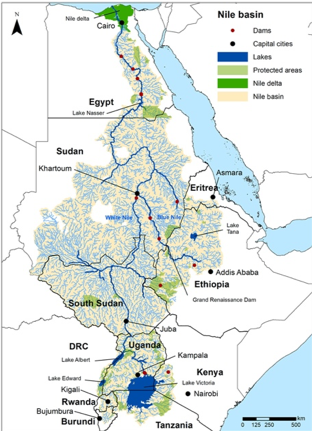
The construction of the Grand Ethiopian Renaissance Dam (GERD), Africa’s largest dam, has been fraught with problems including corruption scandals ( Ljubas 2019 ), death of the chief engineer ( Champion and Manek 2019 ) and military threats ( Walsh and Sengupta 2020 ). Additionally, it was recently reported that GERD negotiations have reached another stalemate, after Egypt, Ethiopia and Sudan failed to agree on a procedure to complete talks ( Abdallatif 2020 ).  Whilst in the last post we explored how water provision is influenced by politics at a national scale, GERD demonstrates international scale African hydropolitics. This post will explore how the Nile, a transboundary water resource, has led to political tensions between countries. It provides an insight into key factors affecting the latest GERD disputes and some background to help you follow future updates. The Nile  The Nile basin covers 3.3million km 2 , spanning 11 countries (fig. 1). The two main tributaries of th...

Blog post 4: Cape Town water crisis - just another political game?

Image
Around mid-2017 friends and family in Cape Town started talking about their fears of running out of water. By the end of the year my social media feeds were full of shared posts about water conservation. On the 1st of February 2018, the South African government increased Cape Town’s mandatory water restrictions, limiting water use to 50 litres/person/day ( City of Cape Town 2018 ). Recommendations accompanying the restriction included only one toilet flush a day and one laundry load a week ( CBC 2018 ). Additional water had to be bought (if you were lucky enough to find some) or collected from natural springs in the city (fig. 1). All of this was in an effort to avoid “Day Zero” – the day the city runs out of water. This post will explore whether this crisis was caused by poor environmental conditions or politics.  Figure 1. Messages from my friend at the University of Cape Town who was experiencing the drought first hand. So, who or what caused this crisis? Drought? Well let’s pr...

Blog post 3: Show me a drought and I’ll show you a dysfunctional government

Image
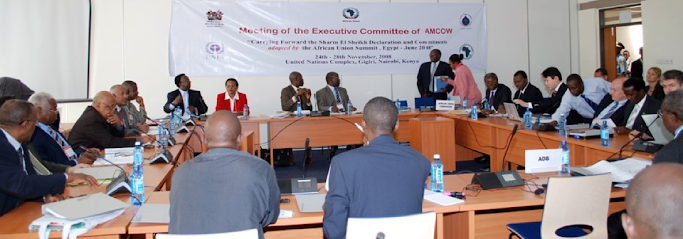
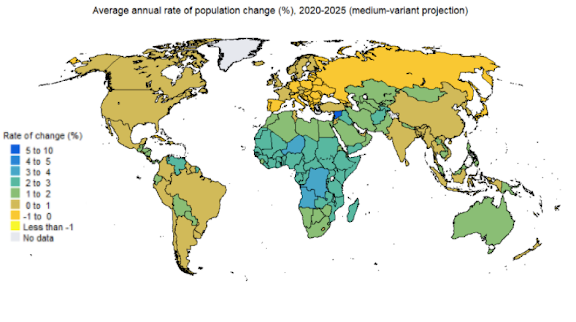
Previously I mentioned Watkins argument that inequality and power imbalances are central to water crises ( 2006 ). This idea is likely to feature a lot throughout my blog as power is inherent to politics whereby groups of people make decisions ( Axford et al. 1997 ). This post will outline how the physical landscape and climate of Africa contributes to inequality. It aims to contextualise my blog and provide a grounding from which we can explore how this inequality has (or has not) been compounded by politics in future posts.  Photo from meeting of the Executive Committee of the African Ministers’ Council Water (AMCOW) whose mission is to provide ‘ political leadership, policy direction and advocacy in the provision, use and management of water resources’. Source Freshwater availability The terms ‘water scarcity’ and ‘water stress’ are often used to describe a country or region’s freshwater availability. Whilst there is much debate over their definitions, values of 1700m 3 /capit...

Blog post 2: Liquid gold

Image
This is a quick post about a video I came across and wanted to share. Although it gives a global overview of the water crises, I think it nicely summarises why water and freshwater management is important as well as portraying its political nature.  Source Whilst some of the case studies mentioned in the video are from countries elsewhere in the world, the broader issues they touch upon, such as transboundary resource issues (Colorado River) and local water conflicts (Mexicali), can also be explained using case studies from around Africa. One line from the video that particularly stood out to me was:  " The more scarce water gets, the more access to it becomes a competition with winners and losers, often with governments picking." Not only is this highly relevant to the blog but it also suggests that water will become increasingly politicised in the future as climate change leads to increased water scarcity ( UN 2020 ).

Blog post 1: Introductions

Image
Hello and welcome to my blog where I discuss hydropolitics in Africa! This blog post is a quick introduction to me and why I'm passionate about African hydropolitics. It will also give a brief insight into why water is such an important political issue and touch upon some topics I hope to explore more in future posts. I grew up in the cultural melting pot that is Johannesburg, South Africa, and this sparked my interested in the Africa continent. Although whilst living there I experienced hosepipe bans and occasional water shortages due to poorly maintained water pipes, it was not until I moved to the U.K. that the topic of hydropolitics in Africa really grabbed my attention. When back visiting Johannesburg, I volunteered at the Yeoville Community School which caters to children with challenging socioeconomic backgrounds.  Most of the children I met lived in informal housing in the surrounding townships, such as Alexandra, Vooslorus and Orange Farm and almost all of them looked for...